
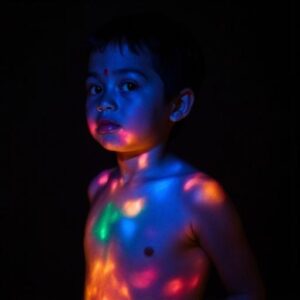
Many parents first hear about aura colors when their child says something unexpected.
“I can see colours around people.”
“You glow blue when you’re calm.”
“His colour feels heavy.”
For parents, this can be confusing, fascinating, or even worrying. Is it imagination? Intuition? Something symbolic? Or something more literal?
Understanding aura colors meaning, especially in children, doesn’t require belief in anything supernatural. It requires understanding how emotion, sensitivity, perception, and intuition work together in children who feel and observe more than most.
This guide explains aura colors in a parent-friendly, grounded way, focusing on what children experience, how parents can respond, and how these perceptions can be supported rather than dismissed or exaggerated.
What Is an Aura (In Simple Terms for Parents)?
An aura is commonly described as a field of energy, emotion, or presence that surrounds a person. In practical terms, for children, aura perception is often:
- A visual way of describing how someone feels
- A symbolic language for emotional or intuitive awareness
- A form of synesthetic perception (where senses overlap)
- A child’s way of translating subtle cues into colour
Children rarely see auras the way adults describe them in spiritual books.
They don’t analyze them.
They don’t label them.
They simply report what they notice.
For many spiritually sensitive children, colours are the simplest language their mind uses to explain feelings and impressions.
Why Children Notice Aura Colors More Easily Than Adults
Children are naturally intuitive for several reasons:
- They are emotionally open
- They have not learned to suppress perception
- They observe without judgment
- They live more in feeling than logic
A child who sees aura colors is not necessarily “seeing energy” in a mystical sense. Often, they are translating emotional awareness into colour, the same way some children associate sounds with shapes or numbers with personalities.
This sensitivity usually appears between ages 3–9, then either fades, stabilizes, or becomes internalized as intuition rather than visuals.
How Aura Colors Appear to Children
Children describe aura colors in very specific ways:
- “It’s like fog”
- “It’s like light”
- “It’s fuzzy”
- “It moves”
- “It’s brighter when people are happy”
- “It goes dark when someone is angry”
They rarely describe sharp outlines or dramatic effects.
The experience is subtle, fluid, and emotional rather than visual like a cartoon glow.
Common Aura Colors and What They Often Mean for Children
Below are the most commonly reported aura colors from parents and children, explained in ways that help parents respond appropriately.
Blue Aura — Calm, Thoughtful, Sensitive
Children describe blue auras as:
- Calm
- Cool
- Soft
- Quiet
- Safe
A child who sees blue around someone usually feels comfortable or soothed by them.
What it often reflects:
- Emotional stability
- Kindness
- Thoughtfulness
- Safety
How parents can respond:
- Encourage calm expression
- Allow quiet time
- Respect emotional depth
Children with blue perceptions often need peaceful environments and time to recharge.
Green Aura — Healing, Empathy, Balance
Green is often reported around:
- Parents
- Caregivers
- Animals
- Nature-loving people
Children associate green with:
- Feeling better
- Comfort
- Safety
- Trust
What it often reflects:
- Emotional healing
- Compassion
- Nurturing energy
- Balance
How parents can respond:
- Encourage time in nature
- Support caregiving instincts
- Teach boundaries so they don’t over-give
Green-sensitive children often take on emotional responsibility early.
Yellow Aura — Joy, Curiosity, Mental Energy
Yellow is commonly described as:
- Bright
- Fast
- Busy
- Sparkly
Children often see yellow around:
- Other children
- Teachers
- Creative people
- Excitable adults
What it often reflects:
- Curiosity
- Learning
- Playfulness
- Mental activity
How parents can respond:
- Provide creative outlets
- Allow questions
- Encourage play without overstimulation
Too much yellow energy can overwhelm sensitive kids, so balance is important.
Purple or Violet Aura — Intuition, Depth, Awareness
This colour often appears in children who are deeply intuitive.
Children describe purple as:
- Quiet
- Deep
- Soft but strong
- “Important”
What it often reflects:
- Intuition
- Inner awareness
- Reflection
- Emotional intelligence
How parents can respond:
- Encourage journaling or drawing
- Allow alone time
- Avoid pushing social pressure
Children who notice purple often struggle in loud, chaotic environments.
Pink Aura — Love, Gentleness, Emotional Safety
Pink is usually associated with:
- Mothers
- Babies
- Loved ones
- Safe adults
Children feel pink rather than “see” it strongly.
What it often reflects:
- Emotional warmth
- Affection
- Kindness
- Comfort
How parents can respond:
- Reinforce emotional expression
- Encourage gentle play
- Teach emotional boundaries
Pink-sensitive children are emotionally open and easily hurt by harsh words.
White or Light Aura — Peace, Protection, Neutrality
White or light colours are often reported during:
- Bedtime
- Quiet moments
- Comforting experiences
Children may say:
- “They shine”
- “They’re bright”
- “They glow softly”
What it often reflects:
- Calm
- Neutral emotional state
- Safety
- Clarity
How parents can respond:
- Maintain calming bedtime routines
- Use soft lighting
- Encourage grounding practices
White/light perception often appears during emotional regulation.
Red Aura — Strong Emotions, Anger, Overwhelm
Red is one of the most misunderstood aura colours.
Children describe red as:
- Loud
- Heavy
- Hot
- Too close
They often notice it during arguments or stress.
What it often reflects:
- Anger
- Frustration
- Strong emotions
- Overstimulation
How parents can respond:
- Reduce exposure to conflict
- Teach emotional cooling techniques
- Normalize big feelings without fear
Red perception does not mean danger — it means intensity.
Dark or Grey Aura — Sadness, Exhaustion, Emotional Weight
Children sometimes say:
- “Their colour feels heavy”
- “It’s dark”
- “It makes me tired”
This usually reflects emotional states, not anything ominous.
What it often reflects:
- Sadness
- Fatigue
- Stress
- Emotional burden
How parents can respond:
- Ask gentle questions
- Encourage rest
- Reassure children they are not responsible for others’ emotions
Sensitive children often absorb emotional weight unconsciously.
Do Aura Colors Mean the Same Thing for Every Child?
No.
This is crucial for parents to understand.
Aura colors are subjective experiences, not fixed rules.
One child’s “blue” may feel different to another child’s “blue”.
What matters is:
- How the child feels
- What the colour represents to them
- How it affects their emotional state
Parents should always ask:
“What does that colour feel like to you?”
Not:
“What does that colour mean?”
How Parents Should Respond When a Child Talks About Aura Colors
1. Stay Neutral
Avoid excitement or fear.
A calm response keeps the child grounded.
2. Validate Without Interpreting
Say:
- “That sounds interesting.”
- “Thank you for telling me.”
- “How did it make you feel?”
3. Avoid Labels
Don’t rush to define the experience.
Let the child describe it naturally.
4. Teach Emotional Boundaries
Help children understand they don’t need to carry others’ feelings.
5. Encourage Expression
Drawing, journaling, or storytelling helps children process what they notice.
Activities to Help Children Understand Aura Perception
- Colour Journals – draw colours they notice and how they felt
- Emotion Matching – match colours to emotions after daily events
- Nature Time – helps reset emotional sensitivity
- Quiet Reflection – before bed, discuss what felt calm or heavy
These activities ground perception into emotional awareness rather than fear.
When Aura Perception Fades — and Why That’s Normal
Many children stop noticing aura colors as they grow older.
This does not mean the sensitivity disappears.
It often becomes:
- Intuition
- Emotional intelligence
- Empathy
- Strong perception of people’s moods
The visual language fades, but the awareness remains.
What Aura Colors Really Teach Parents
Aura colors are not about predicting futures or labeling children.
They are about understanding:
- Emotional sensitivity
- Intuitive awareness
- How children perceive the world
When parents listen calmly, children feel safe.
When children feel safe, sensitivity becomes a strength.