
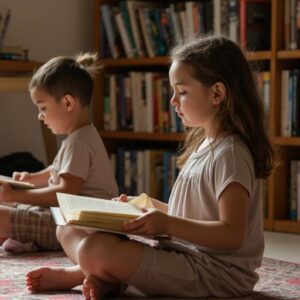
Understanding Spiritual Development for Children in Everyday Life
Spiritual development for children doesn’t begin with lessons, beliefs, or explanations. It begins quietly — through awareness, sensitivity, imagination, emotional depth, and a child’s natural connection to the unseen parts of life.
Many parents first notice it when their child asks unexpected questions, reacts deeply to emotions in a room, speaks about dreams as if they were experiences, or senses things they can’t easily explain. Others notice it during moments of calm: when a child sits silently, watches nature, or expresses understanding far beyond their age.
Spiritual development in children is not something parents need to create. It is something that unfolds on its own — and the role of the parent is not to direct it, but to support it without fear or pressure.
What Spiritual Development Looks Like in Children
Spiritual development does not follow a single pattern. It shows up differently depending on the child’s temperament, environment, and emotional maturity.
Some common expressions include:
- Heightened emotional awareness
- Strong intuition or “gut feelings”
- Deep empathy for others
- A natural sense of fairness and compassion
- Comfort with silence or solitude
- Strong imaginative or creative expression
- Vivid dreams or symbolic thinking
- Sensitivity to environments, people, or moods
These traits are often mistaken for being “too sensitive,” when in reality they reflect a child who is developing inner awareness earlier than most.
Why Children Develop Spiritually Earlier Than Adults
Children have fewer mental filters. They are not yet conditioned to dismiss feelings, ignore instincts, or suppress imagination. Their inner world is active, fluid, and open.
As children grow older, social conditioning teaches them to prioritize logic, performance, and external validation. Spiritual development often quiets during these years — not because it disappears, but because it becomes buried under expectations.
When spiritual development shows itself clearly in childhood, it is often because the child has not yet learned to disconnect from that inner awareness.
Spiritual Development Is Not About Beliefs
One of the most important things for parents to understand is that spiritual development for children is not about teaching ideas.
It is about:
- Awareness
- Emotional intelligence
- Inner safety
- Self-trust
- Connection
A spiritually developing child does not need explanations for everything they feel or sense. They need permission to experience without being rushed into interpretation.
The Parent’s Role in a Child’s Spiritual Development
Parents do not need to be spiritual experts. In fact, trying to explain or define experiences too early can confuse a child or make them feel misunderstood.
The most supportive roles a parent can play are:
1. Being Calm and Neutral
A child reads emotional cues closely. When parents respond with calm curiosity instead of fear or dismissal, the child feels safe enough to keep sharing.
Simple responses work best:
- “That sounds important to you.”
- “Thank you for telling me.”
- “How did that make you feel?”
2. Focusing on Feelings First
Before addressing what a child experienced, address how it made them feel.
A child who feels understood emotionally will naturally develop confidence in their inner awareness.
3. Encouraging Expression Without Judgment
Children process inner experiences through:
- Drawing
- Storytelling
- Movement
- Play
- Quiet reflection
Allowing these forms of expression without analysis helps development remain healthy and balanced.
4. Avoiding Labels
Labeling a child as “special,” “gifted,” or “different” can place pressure on them.
Spiritual development is not an identity — it is a process.
Emotional Development and Spiritual Development Are Closely Linked
Children who are spiritually developing often experience emotions more intensely. This does not mean they are fragile — it means they are perceptive.
Parents can support this by:
- Naming emotions gently
- Teaching emotional regulation through breathing and grounding
- Normalising emotional ups and downs
- Avoiding punishment for emotional expression
Spiritual development strengthens when emotional safety is present.
The Role of Imagination in Spiritual Development
Imagination is often misunderstood as “just pretending.” In children, imagination is how inner awareness organizes itself.
Through imagination, children:
- Explore meaning
- Process experiences
- Understand emotions
- Experiment with perspective
Rather than discouraging imagination, parents should see it as a developmental tool, not a distraction.
Dreams and Inner Processing
Children often process spiritual awareness through dreams long before they can explain it during the day.
Parents can support this by:
- Letting children talk about dreams without correcting them
- Asking open questions (“What did it feel like?”)
- Encouraging drawing or journaling
- Avoiding dismissal or over-interpretation
Dreams are a natural part of inner development, especially in emotionally aware children.
Boundaries Are Essential for Healthy Development
Spiritual development thrives when children feel safe and in control.
This includes teaching:
- Emotional boundaries (“You don’t have to carry other people’s feelings.”)
- Personal boundaries (“You can say no.”)
- Inner boundaries (“You are allowed to feel calm.”)
Simple grounding techniques — such as breathing, visualization, or quiet time — help children learn self-regulation.
Nature as a Natural Regulator
Nature plays a powerful role in spiritual development for children.
Time spent outdoors helps:
- Calm heightened sensitivity
- Regulate emotions
- Reduce mental overload
- Strengthen connection to the present moment
Children who seem overwhelmed indoors often settle quickly when given space in nature.
When Spiritual Development Feels Overwhelming
While spiritual development is natural, it can sometimes feel intense for children who lack emotional tools.
Parents should offer additional support if a child:
- Becomes consistently anxious
- Struggles with sleep for extended periods
- Withdraws socially
- Expresses confusion or distress about inner experiences
Support does not mean suppression — it means balance and reassurance.
What Parents Should Avoid
Certain responses can unintentionally shut down healthy development:
- Dismissing experiences as “nothing”
- Reacting with fear
- Over-analysing or explaining too much
- Forcing interpretations
- Comparing the child to others
Children thrive when their experiences are acknowledged without being exaggerated or minimized.
Spiritual Development Is Not Linear
Some children show strong awareness early and then appear to “grow out of it.” Others develop more gradually. Some revisit spiritual awareness later in adolescence or adulthood.
All of this is normal.
Spiritual development is not something to track, measure, or rush.
Building Long-Term Inner Confidence
Children who are supported in their spiritual development often grow into adults who:
- Trust their intuition
- Regulate emotions effectively
- Show empathy without burnout
- Think independently
- Maintain inner stability
The foundation for this is not instruction — it is emotional safety and trust.
A Grounded Perspective for Parents
You do not need to have answers.
You do not need to define experiences.
You do not need to guide your child toward any belief system.
You only need to:
- Listen
- Stay calm
- Support expression
- Offer reassurance
- Encourage balance
Spiritual development for children unfolds best when it is allowed to be natural, quiet, and unforced.
Your role is not to lead the journey — it is to walk beside them while they discover their own inner world.
Related Guides
- Spiritual Awakening in Children: How Parents Can Recognize, Support & Nurture Their Child’s Early Sensitivity
- What Is Spiritual Development of a Child? A Parent’s Guide
- Spiritual Activities for Children: Practical Tools That Help Sensitive Kids Feel Calm and Safe
- spiritual development and awakening in children